
Yeserday was the sixtieth anniversary of the start of the Berlin Airlift.
In June of 1948, the Soviet Union blocked all ground and water access to the Allied controlled portions of Berlin. The US and Royal Air Forces responded with the largest humanitarian airlift ever attempted. For over 300 days all food, medical supplies and fuel needed for over 2 million people were flown into the city. At the high point, a plane was landing every 90 seconds, 24 hours a day. Berliners worked at unloading the planes. Their efficiency was such that one 10 ton load was unloaded in under six minutes. Each flight crew flew multiple round trips per day. By late April 1949, the Airlift was bringing over 8000 tons of material, per day into the city. This was more that had been brought into city by rail prior to the blockade. On April 25, 1949, realizing that the airlift had reached a point where it could be carried on indefinitely, the Soviet Union called off the blockade. The airlift continued for another three months so as to create a stockpile of supplies within the city in case the airlift needed to restarted. In total 2,326,406 tons of supplies were airlifted. There were 278,228 total flights into Berlin. There were 101 people including 31 Americans who lost their lives in the operations, mostly from crashes.
One US pilot, Gail Halvorsen started dropping candy from his plane to the children waiting outside of the runway. His example was expanded and the flight became known as "Candy Bombers". Over three tons of candy were eventually dropped.
The Berlin Airlift was one the pivotal moments of the 20th century. Without it, the Western Alliance might not have formed, and the Cold War would have started with a Soviet victory.
Thursday, June 26, 2008


Monday, June 23, 2008
George Carlin, RIP
Shit, Piss, Fuck, Cunt, Cocksucker, Motherfucker and Tits.
You can prick your finger, but don't finger your prick.
George Carlin has died at 71 of heart failure.
You can prick your finger, but don't finger your prick.
George Carlin has died at 71 of heart failure.
Thursday, June 19, 2008
Google Maps "Street View" hits Tulsa
Google has driven its funny van around Tulsa it seems. Street View is available for Tulsa. This is both pretty cool and kind of creepy. A while back, I called a friend in the DFW region and was able to describe his house, which I have never visited, to him, all courtesy of Street View. Kind of has a big brother aspect to it, especially when combined with the satellite views available on Google maps. I am sure that some criminals are finding this very useful data.
On the other hand, this will help a great deal with my research on Tulsa's architectural history. Rather than actually driving around to do my scouting I can sit here in Bartlesville in my underwear. With the current gas prices, this is great.
A down side, is that they don't seem to be done. There are blank spots all over the map. Especially troublesome is the large swath between Harvard and Yale from Pine to 41st Street, which has only about 15% of the streets covered. I notice that Tulsa doesn't have the little camera icon as you zoom out. OKC does and seems to have many fewer holes, so perhaps they are still driving, or processing data, or something.
On the other hand, this will help a great deal with my research on Tulsa's architectural history. Rather than actually driving around to do my scouting I can sit here in Bartlesville in my underwear. With the current gas prices, this is great.
A down side, is that they don't seem to be done. There are blank spots all over the map. Especially troublesome is the large swath between Harvard and Yale from Pine to 41st Street, which has only about 15% of the streets covered. I notice that Tulsa doesn't have the little camera icon as you zoom out. OKC does and seems to have many fewer holes, so perhaps they are still driving, or processing data, or something.
Bobbio Orosius
Cross posted from Monstrous Beauty.
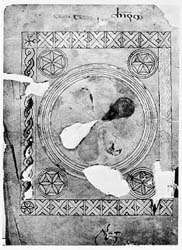 The Bobbio Orosius, from the 7th century, introduces an important motif to insular art, the Carpet Page. This is the oldest surviving carpet page. The design is not similar to the Carpet Pages in the later more famous gospel books (Durrow, Lindisfarne, Kells), but its purpose seem to have been similar; To serve as a sort of internal cover. As Dr. J. Kirsten Ataoguz points out over at Early Medieval Art, the Bobbio Orosius carpet page can be compared, at least in layout to the cover of the Stoneyhurst Gospels. (see below for image.) Like the later gospel books this carpet page faces a decorated initial. (I regret not having an image of the initial, and the poor image of the carpet page here, but it is all that is available on the net.)
The Bobbio Orosius also represents an important movement in the religious and artistic history of Europe. Although the manuscript was produced at a monastery in Italy, it was produced by Irish monks. The monastery in question, Bobbio was founded by St. Columbanus, who was from Ireland. Many important communities on the continent were founded by Irish monks. Many of the important "insular" manuscripts were in fact produced in the scriptoria of these communities. These monasteries were to play a vital role in the religious and artistic life of the next several centuries.
The manuscript itself (Milan, Biblioteca Ambrosiana MS D. 23. Sup.) is a copy of the Chronicon of Orosius. In the seventtenth century it was given to the newly established Ambrosian Library in Milan, where it remains today. Dr. Ataoguz also has a discussion of this manuscript at Early Medieval Art.
The Stonyhurst Gospel Covers

The Bobbio Orosius, from the 7th century, introduces an important motif to insular art, the Carpet Page. This is the oldest surviving carpet page. The design is not similar to the Carpet Pages in the later more famous gospel books (Durrow, Lindisfarne, Kells), but its purpose seem to have been similar; To serve as a sort of internal cover. As Dr. J. Kirsten Ataoguz points out over at Early Medieval Art, the Bobbio Orosius carpet page can be compared, at least in layout to the cover of the Stoneyhurst Gospels. (see below for image.) Like the later gospel books this carpet page faces a decorated initial. (I regret not having an image of the initial, and the poor image of the carpet page here, but it is all that is available on the net.)The Bobbio Orosius also represents an important movement in the religious and artistic history of Europe. Although the manuscript was produced at a monastery in Italy, it was produced by Irish monks. The monastery in question, Bobbio was founded by St. Columbanus, who was from Ireland. Many important communities on the continent were founded by Irish monks. Many of the important "insular" manuscripts were in fact produced in the scriptoria of these communities. These monasteries were to play a vital role in the religious and artistic life of the next several centuries.
The manuscript itself (Milan, Biblioteca Ambrosiana MS D. 23. Sup.) is a copy of the Chronicon of Orosius. In the seventtenth century it was given to the newly established Ambrosian Library in Milan, where it remains today. Dr. Ataoguz also has a discussion of this manuscript at Early Medieval Art.
The Stonyhurst Gospel Covers
Friday, June 13, 2008
Roman D&D
 It seems that a 2nd century Roman glass twenty sided die was auctioned by Christie's for $18,000. The auction notes said that "Modern scholarship has not yet established the game for which these dice were used." But, we know, don't we.
Seriously, this is very cool. I wonder if they made four sided dice as well. And then stepped on them in the middle of the night.
Thursday, June 12, 2008
Unicorns and Dragons and CERN, oh my
Unicorns are real! I think we should rethink the plan those crazy physicists at CERN have for creating dragons.
Texas Governor's Mansion
 This is a few days old, but there was major fire at the Texas Governor's Mansion in the early morning last Sunday. It appears to have been arson. Although I hate to see any historic structure lost or damaged, this one hits a little closer to home. When we lived in Austin, there was a major bus transfer point in front of the mansion. I spent a lot of time waiting on buses admiring the mansion. We always said that we ought to tour the mansion some time, but never did. This should be a lesson to not assume that things will always be around. Gather rosebuds while you may.
The good news is the the mansion was in the middle of a major renovation (which is why security was so lax) and all of the artworks, furniture, and artifacts were in storage. The bad news is that a lot of the historic fabric is gone. For example, the banister rail had filled holes where Governor Jim Hogg had driven nails to keep his kids from sliding down the banister. From the pictures I've seen, that rail is a complete loss.
The picture above is courtesy of the Texas Governor's Office. The Governor's office has also posted more images of the damage here. Governor Perry has vowed to rebuild, whatever the cost. I saw one estimate that said that other similar structure with comparable damage cost 20 million dollars to repair. If I know Texas that are probably several dozen rich dudes who would be willing and able to foot the entire bill. I also can't imagine the Texas legislature not coming up with the money.
Wednesday, June 11, 2008
The Kiddie Park
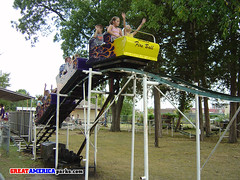
Today we renewed a family tradition. We went to the Kiddie Park in Johnstone Park. For those not from Bartlesville, the Kiddie Park is small amusement park in Bartlesville primarily aimed at small children. The perfect age is 5. By the time a child gets to six some of the rides are already too small. The park is maintained mainly through donations and volunteers. There are sixteen rides, most of them variants of going around slowly in a circle. Many of the rides are vintage things kept running through loving care. The biggest ride is the roller coaster. The highest hill is about 12 feet tall. Tickets cost 25 cents and most of the rides cost 1 ticket. The remainder cost 2 tickets.
One of the highlights is the miniature train which runs out into Johnstone Park and back, running through a "tunnel" (really the shed the train is kept in in the winter) where it is traditional for young girls to scream in pitches not usually possible for humans. If you stay until closing time, the last train ride is free.
It's a gentle place. There are loud speakers playing music, but unless you right under them they serve mostly as background noise. None of the rides have loudspeakers or the like, so they just make a quiet clacking sound as they run. The child to adult ratio is pretty close to 1:1 the families with Mom, Dad, and grandparents along to watch the single child have fun, match the few families with multiple kids. The kids are remarkably well behaved. The kids running the rides are basically recent graduates from being customers. The park hires 14 and 15 year old kids, giving them an early chance at learning job skills and get some experience. because of the short hours and sub-minimum wage pay the kids can expect to earn about 400 bucks a summer. The Elder Daughter is already plotting what she will do with her riches when she is old enough to work there in a few years.
I was very glad to be able to got today. I was worried Monday. Last year the flooding in Bartlesville flooded the Park. It was closed most of the summer. Monday the river was up high again. Some major roads were closed and the water was into Johnstone Park. The Kiddie Park stayed dry and the water was ten feet lower today.
The kids had good time. The Younger Daughter rode the roller coaster for the first time and came off squeaking "I love it, I love it". The Elder Daughter got in four rides. The younger daughter demonstrated that you can dye significant portions of your body blue with a single snow cone. (BTW, who in the hell decided that blue was the appropriate color for raspberry?) The only down side is that a few of the rides including the train were down for repairs. With luck, and if the river don't rise, we will be back a dozen or more times this summer.
Note: The picture above is from Flickr and not from today's trip.
One of the highlights is the miniature train which runs out into Johnstone Park and back, running through a "tunnel" (really the shed the train is kept in in the winter) where it is traditional for young girls to scream in pitches not usually possible for humans. If you stay until closing time, the last train ride is free.
It's a gentle place. There are loud speakers playing music, but unless you right under them they serve mostly as background noise. None of the rides have loudspeakers or the like, so they just make a quiet clacking sound as they run. The child to adult ratio is pretty close to 1:1 the families with Mom, Dad, and grandparents along to watch the single child have fun, match the few families with multiple kids. The kids are remarkably well behaved. The kids running the rides are basically recent graduates from being customers. The park hires 14 and 15 year old kids, giving them an early chance at learning job skills and get some experience. because of the short hours and sub-minimum wage pay the kids can expect to earn about 400 bucks a summer. The Elder Daughter is already plotting what she will do with her riches when she is old enough to work there in a few years.
I was very glad to be able to got today. I was worried Monday. Last year the flooding in Bartlesville flooded the Park. It was closed most of the summer. Monday the river was up high again. Some major roads were closed and the water was into Johnstone Park. The Kiddie Park stayed dry and the water was ten feet lower today.
The kids had good time. The Younger Daughter rode the roller coaster for the first time and came off squeaking "I love it, I love it". The Elder Daughter got in four rides. The younger daughter demonstrated that you can dye significant portions of your body blue with a single snow cone. (BTW, who in the hell decided that blue was the appropriate color for raspberry?) The only down side is that a few of the rides including the train were down for repairs. With luck, and if the river don't rise, we will be back a dozen or more times this summer.
Note: The picture above is from Flickr and not from today's trip.
Tuesday, June 10, 2008
Tulsa Architecture, Hooper Brothers Coffee
 This is one of my favorite historical buildings in Tulsa, in part because I can find it, and most people don't know that it exists. It took me the better part of an hour to find it the first time though. It is in downtown, being within the inner dispersal loop, but just barely.
The building was built in 1924 and was active in the coffee business until 1961. The railroad tracks run right behind the building. Coffee beans were unloaded directly into the building, where they were roasted and ground. The coffee making machinery is long gong. In 1978, when the building was added to National Register of Historic Places, it still had the last working hydraulic elevator in Tulsa. The architect and builder are unknown. It is a rare survival of a 1920s commercial building.
The view above is the from the southwest. Below the view from the northwest.

The sign reading "Hooper Bros Coffee" on the front of the building is raised brickwork.

As can be seen above, the south facade has rectangular windows. There are panels with raised decorative brickwork between the windows of the two stories.

The windows on the west facade have low arches.


The west facade had a painted sign that is still faintly visible.

The north facade also had a painted sign that can only be seen in the lessened wearing of the bricks.

The corners of the building do not meet squarely, causing them to have a jagged appearance. The corner below in an "interior" corner. It is on the south facade, along the west edge of the, now boarded over, main doorway. I assume it represents an extension of an interior wall that was not built at a right angle to the south exterior wall. The southwest corner of the building has a similar appearance.

The Beryl Ford Collection at the Tulsa Library did not have any vintage images of this building online. They did have an image of the 1940 Hooper Brothers Coffee calendar.

Thanks to my brother for the photography of the building and to the Beryl Ford Collection/Rotary Club of Tulsa, Tulsa City-County Library and Tulsa Historical Society for the calendar image.
Monday, June 9, 2008
Buy Danish
My Brother has a "Buy Danish" logo on his blog. Here is an example of why. The subtitles suffered a bit in translation. "I have neutralized one...motherfucker", and the ever popular ">taunting<".
Saturday, June 7, 2008
Cathach of St. Columba
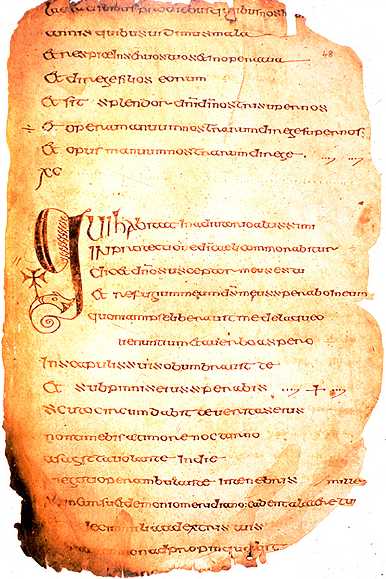 The Cathach of St. Columba is the starting point for Celtic manuscripts. The traditional story is that Columba was lent a psalter by St. Finnian on the condition that he not copy it. Columba nevertheless copied in a single miraculous all-night session. When Finnian discovered the manuscript, he appealed to the local king, who awarded the copy to Finnian. Columba raised his kinsmen which resulted in the Battle of Cúl Dreimhne. Columba went into exile, where he founded Iona, as penance for the men killed in the battle. The Cathach is traditionally identified with Columba's copy. The Cathach, however, has been dated to the 7th century on paleological grounds. Throughout the Middle Ages it was carried into battle as a talisman, a practice from which it gets it name. "Cathach" means "battler" in Irish.
The decoration in the Cathach is limited to the first few letters of each Psalm. This decoration establishes several themes that are explored in great depth in later manuscripts. The first letter of each Psalm is enlarged. In earlier manuscripts initial letters had been enlarged and decorated. Bit the decorations in those manuscripts were used to fill space or were appended to the latter. In the Cathach, the decoration distorts the shape of the letter, so that the letter becomes the decoration. Subsequent letters were drawn into the decoration through the gradual shrinking of the letters. In earlier manuscripts the letters after the first letter were the same size as the he rest of the text. In the Cathach, each subsequent letter is a bit smaller than the preceding letter until the letters reach the size of the bulk of the text. The letters are often decorated with small red dots. These three ideas the distortion of letters for decoration, the dimidation of letters, and the use red dots for decoration are ideas worked out in great detail later.
Friday, June 6, 2008
D-Day
Forty four years ago today, thousands of young men endured a horror I cannot imagine. By the end of the day, they had changed the future of the world. Every day fewer and fewer of those young men are left. The Tulsa World ran a profile on one of them today.
Here are the memories of some of the other those men.
Here are the memories of some of the other those men.
Monday, June 2, 2008
NPR can't say hero.
Today, as I was driving to work, NPR ran a short story saying that President Bush would be honoring PFC Ross McGinnis today. Although they described the act of heroism, throwing himself on a grenade in order to save four other soldiers, they never mentioned what he was being awarded. It was, of course, the Medal of Honor, posthumously. According to Wikipedia McGinnis is on of US servicemen to have thrown themselves on live grenades. The others were Marine Cpl. Jason Dunham, Navy SEAL Petty Officer 2nd Class Michael A. Monsoor, and Marine Rafael Peralta. Dunham and Monsoor were awarded the Medal of Honor and Peralta is waiting presidential approval.
5th century Coptic manuscript.

This manuscript represents a bit of a frustration for me. I had read Weitzmann, and some other sources so I thought I had a pretty good idea what were the important manuscripts. Then I checked out Lorenzo Crinelli's, Treasures from Italy's Great Libraries
 (New York, The Vendome Press, 1997). One of the early manuscripts was this 5th century Coptic Old Testament fragment (Naples, Biblioteca Vittorio Emanuele III, 1 B 18). Illustrated here is Job and his daughters. I wrote an article about it for Wikipedia. It makes me wonder though, how many more very early manuscripts am I missing? Are there other 5th century Coptic manuscripts. What about other eastern manuscripts. I know about Syriac manuscripts (The Rabula Gospels and the Bible in Paris) are there more? I haven't found a text in English on Coptic manuscripts, although there are some in French. It may be worth my while to struggle through them.
All of that aside, so that you won't have go read the Wikipedia article, here are the basics. This is a fragment of 5th century manuscript of the Old Testament written in the Coptic language. The manuscript has only 8 surviving folios and includes the text from the Book of Job and from Proverbs. One folio has a large pen drawing illustrating Job and his daughters with Job pictured as a bearded man wearing a crown and short tunic. His daughters wear tunics with jewels and diadems. The iconography of Job is very different in this manuscript from that in later centuries. Here he is seen as royal figure while in later portrayals he is seen as humbled and sitting on a dung heap.
Monday, May 26, 2008
Shines the name, shines the name
There seem to be few songs that celebrate individual or small groups of real soldiers or sailors. There is of course "The Sinking of the Reuben James", there is also the "Ballad of Ira Hayes", but that is really something different. And then there is the "Ballad of Roger Young", Roger Young and the Ballad are familiar to ever reader of Heinlein, of course, but he like so many heroes have otherwise slowly fallen into anonymity.
From his Medal of Honor citation (courtesy of Wikipedia)
On July 31, 1943, the infantry company of which Pvt. Young was a member, was ordered to make a limited withdrawal from the battle line in order to adjust the battalion's position for the night. At this time, Pvt. Young's platoon was engaged with the enemy in a dense jungle where observation was very limited. The platoon suddenly was pinned down by intense fire from a Japanese machine gun concealed on higher ground only 75 yards (69 m) away. The initial burst wounded Pvt. Young. As the platoon started to obey the order to withdraw, Pvt. Young called out that he could see the enemy emplacement, whereupon he started creeping toward it. Another burst from the machine gun wounded him the second time. Despite the wounds, he continued his heroic advance, attracting enemy fire and answering with rifle fire. When he was close enough to his objective, he began throwing hand grenades, and while doing so was hit again and killed. Pvt. Young's bold action in closing with this Japanese pillbox and thus diverting its fire, permitted his platoon to disengage itself, without loss, and was responsible for several enemy casualties.
From his Medal of Honor citation (courtesy of Wikipedia)
On July 31, 1943, the infantry company of which Pvt. Young was a member, was ordered to make a limited withdrawal from the battle line in order to adjust the battalion's position for the night. At this time, Pvt. Young's platoon was engaged with the enemy in a dense jungle where observation was very limited. The platoon suddenly was pinned down by intense fire from a Japanese machine gun concealed on higher ground only 75 yards (69 m) away. The initial burst wounded Pvt. Young. As the platoon started to obey the order to withdraw, Pvt. Young called out that he could see the enemy emplacement, whereupon he started creeping toward it. Another burst from the machine gun wounded him the second time. Despite the wounds, he continued his heroic advance, attracting enemy fire and answering with rifle fire. When he was close enough to his objective, he began throwing hand grenades, and while doing so was hit again and killed. Pvt. Young's bold action in closing with this Japanese pillbox and thus diverting its fire, permitted his platoon to disengage itself, without loss, and was responsible for several enemy casualties.
What were their names.
Happy Memorial Day.
The USS Reuben James was the first United States Navy ship lost during World War II. It was named for Reuben James, a US Navy sailor who distinguished himself during the First Barbary War, in part by saving Steven Decatur's life during the burning of the USS Philadelphia.
Have you heard of the ship called the good Reuben James,
Manned by hard fighting men both of honor and of fame?
She flew the Stars and Stripes of the Land of the Free,
But tonight she's in her grave at the bottom of the sea.
CHORUS:
Tell me what were their names, tell me what were their names,
Did you have a friend on the good Reuben James?
What were their names, tell me what were their names?
Did you have a friend on the good Reuben James?
One hundred men were drowned in that dark watery grave;
When that good ship went down, only forty-four were saved.
'Twas the last day of October we saved the forty-four
From the cold icy waters off that cold Iceland shore.
It was there in the dark of that uncertain night
That we watched for the U-boats and waited for a fight.
Then a whine and a rock and a great explosion roared
And they laid the Reuben James on that cold ocean floor.
Now tonight there are lights in our country so bright
On the farms and in the cities they're telling of the fight.
And now our mighty battleships will steam the bounding main
And remember the name of the good Reuben James.
-Woody Guthrie
The officers and men lost on the USS Reuben James, October 31, 1941.
John Francis Bauer Jr., Chief Radioman, USNR
Harold Hamner Beasley , Seaman first class, USN
James Mead Belden, Lieutenant, USNR
James Franklin Benson, Machinist's Mate second class, USN
Joseph Peter Biehl, Seaman second class, USN
Paul Rogers Boynton, Yeoman first class, USN
Harold Lelie Britt, Coxswain, USN
Herbert Ralph Burrell, Seaman second class, USN
Hartwell Lee Byrd, Seaman first class, USN
Leftwich Erastus Carbaugh, Jr., Fireman first class, USN
Joseph James Varuso, Radioman second class, USN
James Brantley Clark, Fire Controlman second class, USN
Raymond Cook, Mess Attendant first class, USN
Carl Eugene Cooperrider, Gunner's Mate third class, USN
Lawrence Randall Cosgrove, Gunner's Mate second class, USN
Alton Adelbert Cousins , Cheif Machinist's Mate (PA), U.S.N.R.,
Charles Beacon Cox, Chief Torpedoman (AA), USN
Dennis Howard Daniel, Yeoman third class, USN
John Justus Daub, Lieutenant (junior grade), USN
Lawrence Delaney Devereau, Chief Boatswain's Mate (PA), U.S.N.R.
Leonidas Camden Dickerson, Jr., Storekeeper third class, USN
Gilbert Joseph Doiron, Water Tender first class, USN
Karl Lee Drinkwalter, Seaman first class, USN
Nebraska Dunston, Mess Attennndant third class, USN
Corbon Dyson, Radioman third class, USN
Heywood Lane Edwards, Lieutenant Commander, USN (Commanding)
Gene Guy Evans, Boilermaker second class, USN
Linn Stewart Evans, Fire Controlman third class, USN
Carlyle Chester Everett, Fireman second class, USN
Edwin Louis Farley, Seaman first class, USN
John Joseph Fitzgerald, Quartermaster third class, USN
William Aloysius Flynn, Torpedoman second class, USN
Hartley Hardy Franks, Ship's Cook second class, USN
Ralph George French, Chief Commissary Steward, USN
Lester Carson Gaskins, Machinist's Mate first class, USN
Benjamin Ghetzler, Lieutenant, USN
John Calvin Greer, Chief Electrician's Mate (PA), USN
Ernest Dwane Grey, Jr., Seaman second class, USN
Arthur Raymond Griffin, Signalman second class, USN
Donald Knapp Gunn, Seaman second class, USN
Charles Waldon Harris, Seaman second class, USN
Charles Chester Hayes, Seaman second class, USN
William Henry Henniger, Gunner's Mate first class, USN
Francis Robert Hogan, Gunners' Mate third class, USN
Hugh House, Gunner's Mate third class, USN
Maurice Woodrow Hudlin, Fireman first class, USN
Joseph Johnson, Mess Attendant first class, USN
Dewey George Johnston, Lieutenant, USN
Glen W. Jones, Chief Quartermaster (PA), USN
Anthony J., Kalanta Boatswain's Mate second class, USN
Leonard A. Keever Chief Machinist's Mate (PA), USNR
Ralph W.H. Kloepper, Signalman third class, Class V-3, USNR
Joseph Gustave Little, Seaman first class, USN
Paul L. Magaris, Radioman first class, USN
William James McKeever, Sean second class, USN
Windell Harmon Merrell, Fireman second class, USN
Auburn F. Merritt, Seaman second class, USN
Gerald Edward Mills, Seaman second class, Class V-1, USNR
Albert J. Mondouk, Chief Water Tender (PA), USNR
Edgar W. Musslewhite, Machinist's Mate first class, USN
Kenneth Cecil Neely, Seaman second class, USN
Aldon W., Neptune Seaman first class, USN
William Harding Newton, Yeoman third class, USN
Harold J. Orange, Seaman second class, USN
Pedro Ortizuela, Officer's Cook first class, USN
Benjamin T. Owen, Seaman first class, USN
William H. Painter, Seaman first class, USN
Joseph J. Parkin, Chief Water Tender (PA), USN
William N. Paterson , Coxswain, USN
Burl G. Pennington, Quartermaster second class, USN
Joseph C. Polizzi, Seaman first class, USN
Corwin D. Porter, Seaman first class, USN
Frederick R. Post, Boatswain's Mate first class, USN
Lee P. Powell, Pharmacist's Mate first class, USN
Elmer R. Rayhill, Seaman second class, USN
Lee Louis N. Reid, Torpedoman first class, Class V-6, USNR
John R. Ress, Seaman first class, USN
James W. Rogers, Seaman first class, USN
John J. Ryan, Jr., Coxswain, USN
Clarence Rygwelski, Seaman second class, USN
Edward Peter Saltis, Boatswain's Mate first class, USN
Eugene Schlotthauer, Chief Water Tender (AA), USN
Sunny J. Settle, Seaman first class, USN
Walter Sorensen, Gunner's Mate third class, USN
Wallace L. Sowers, Seaman second class, USN
Craig Spowers, Ensign, USN
Anthony Gedminus Stankus, Seaman second class, USN
Jerome Stelmach, Seaman first class, USN
Wilton L. Taylor, Fireman first class, USN
George F. Towers, Chief Gunner's Mate (AA), USN
Lewis Aubrey Turner, Signalman third class, USN
Loyd Z. Voiles, Seaman first class, USN
Harold M. Vore, Fireman first class, USN
Howard Voyer Wade, Ensign, USNR
Jesse Weaver, Seaman first class, USN
Chester L. Welch, Fireman second class, USN
Kenneth R. Wharton, Fire Controlman first class, USNR
George Woody, Jr., Seaman first class, USN
Edwin E. Wray, Seaman first class, USN
Thanks to my brother.
The USS Reuben James was the first United States Navy ship lost during World War II. It was named for Reuben James, a US Navy sailor who distinguished himself during the First Barbary War, in part by saving Steven Decatur's life during the burning of the USS Philadelphia.
Have you heard of the ship called the good Reuben James,
Manned by hard fighting men both of honor and of fame?
She flew the Stars and Stripes of the Land of the Free,
But tonight she's in her grave at the bottom of the sea.
CHORUS:
Tell me what were their names, tell me what were their names,
Did you have a friend on the good Reuben James?
What were their names, tell me what were their names?
Did you have a friend on the good Reuben James?
One hundred men were drowned in that dark watery grave;
When that good ship went down, only forty-four were saved.
'Twas the last day of October we saved the forty-four
From the cold icy waters off that cold Iceland shore.
It was there in the dark of that uncertain night
That we watched for the U-boats and waited for a fight.
Then a whine and a rock and a great explosion roared
And they laid the Reuben James on that cold ocean floor.
Now tonight there are lights in our country so bright
On the farms and in the cities they're telling of the fight.
And now our mighty battleships will steam the bounding main
And remember the name of the good Reuben James.
-Woody Guthrie
The officers and men lost on the USS Reuben James, October 31, 1941.
John Francis Bauer Jr., Chief Radioman, USNR
Harold Hamner Beasley , Seaman first class, USN
James Mead Belden, Lieutenant, USNR
James Franklin Benson, Machinist's Mate second class, USN
Joseph Peter Biehl, Seaman second class, USN
Paul Rogers Boynton, Yeoman first class, USN
Harold Lelie Britt, Coxswain, USN
Herbert Ralph Burrell, Seaman second class, USN
Hartwell Lee Byrd, Seaman first class, USN
Leftwich Erastus Carbaugh, Jr., Fireman first class, USN
Joseph James Varuso, Radioman second class, USN
James Brantley Clark, Fire Controlman second class, USN
Raymond Cook, Mess Attendant first class, USN
Carl Eugene Cooperrider, Gunner's Mate third class, USN
Lawrence Randall Cosgrove, Gunner's Mate second class, USN
Alton Adelbert Cousins , Cheif Machinist's Mate (PA), U.S.N.R.,
Charles Beacon Cox, Chief Torpedoman (AA), USN
Dennis Howard Daniel, Yeoman third class, USN
John Justus Daub, Lieutenant (junior grade), USN
Lawrence Delaney Devereau, Chief Boatswain's Mate (PA), U.S.N.R.
Leonidas Camden Dickerson, Jr., Storekeeper third class, USN
Gilbert Joseph Doiron, Water Tender first class, USN
Karl Lee Drinkwalter, Seaman first class, USN
Nebraska Dunston, Mess Attennndant third class, USN
Corbon Dyson, Radioman third class, USN
Heywood Lane Edwards, Lieutenant Commander, USN (Commanding)
Gene Guy Evans, Boilermaker second class, USN
Linn Stewart Evans, Fire Controlman third class, USN
Carlyle Chester Everett, Fireman second class, USN
Edwin Louis Farley, Seaman first class, USN
John Joseph Fitzgerald, Quartermaster third class, USN
William Aloysius Flynn, Torpedoman second class, USN
Hartley Hardy Franks, Ship's Cook second class, USN
Ralph George French, Chief Commissary Steward, USN
Lester Carson Gaskins, Machinist's Mate first class, USN
Benjamin Ghetzler, Lieutenant, USN
John Calvin Greer, Chief Electrician's Mate (PA), USN
Ernest Dwane Grey, Jr., Seaman second class, USN
Arthur Raymond Griffin, Signalman second class, USN
Donald Knapp Gunn, Seaman second class, USN
Charles Waldon Harris, Seaman second class, USN
Charles Chester Hayes, Seaman second class, USN
William Henry Henniger, Gunner's Mate first class, USN
Francis Robert Hogan, Gunners' Mate third class, USN
Hugh House, Gunner's Mate third class, USN
Maurice Woodrow Hudlin, Fireman first class, USN
Joseph Johnson, Mess Attendant first class, USN
Dewey George Johnston, Lieutenant, USN
Glen W. Jones, Chief Quartermaster (PA), USN
Anthony J., Kalanta Boatswain's Mate second class, USN
Leonard A. Keever Chief Machinist's Mate (PA), USNR
Ralph W.H. Kloepper, Signalman third class, Class V-3, USNR
Joseph Gustave Little, Seaman first class, USN
Paul L. Magaris, Radioman first class, USN
William James McKeever, Sean second class, USN
Windell Harmon Merrell, Fireman second class, USN
Auburn F. Merritt, Seaman second class, USN
Gerald Edward Mills, Seaman second class, Class V-1, USNR
Albert J. Mondouk, Chief Water Tender (PA), USNR
Edgar W. Musslewhite, Machinist's Mate first class, USN
Kenneth Cecil Neely, Seaman second class, USN
Aldon W., Neptune Seaman first class, USN
William Harding Newton, Yeoman third class, USN
Harold J. Orange, Seaman second class, USN
Pedro Ortizuela, Officer's Cook first class, USN
Benjamin T. Owen, Seaman first class, USN
William H. Painter, Seaman first class, USN
Joseph J. Parkin, Chief Water Tender (PA), USN
William N. Paterson , Coxswain, USN
Burl G. Pennington, Quartermaster second class, USN
Joseph C. Polizzi, Seaman first class, USN
Corwin D. Porter, Seaman first class, USN
Frederick R. Post, Boatswain's Mate first class, USN
Lee P. Powell, Pharmacist's Mate first class, USN
Elmer R. Rayhill, Seaman second class, USN
Lee Louis N. Reid, Torpedoman first class, Class V-6, USNR
John R. Ress, Seaman first class, USN
James W. Rogers, Seaman first class, USN
John J. Ryan, Jr., Coxswain, USN
Clarence Rygwelski, Seaman second class, USN
Edward Peter Saltis, Boatswain's Mate first class, USN
Eugene Schlotthauer, Chief Water Tender (AA), USN
Sunny J. Settle, Seaman first class, USN
Walter Sorensen, Gunner's Mate third class, USN
Wallace L. Sowers, Seaman second class, USN
Craig Spowers, Ensign, USN
Anthony Gedminus Stankus, Seaman second class, USN
Jerome Stelmach, Seaman first class, USN
Wilton L. Taylor, Fireman first class, USN
George F. Towers, Chief Gunner's Mate (AA), USN
Lewis Aubrey Turner, Signalman third class, USN
Loyd Z. Voiles, Seaman first class, USN
Harold M. Vore, Fireman first class, USN
Howard Voyer Wade, Ensign, USNR
Jesse Weaver, Seaman first class, USN
Chester L. Welch, Fireman second class, USN
Kenneth R. Wharton, Fire Controlman first class, USNR
George Woody, Jr., Seaman first class, USN
Edwin E. Wray, Seaman first class, USN
Thanks to my brother.
Wednesday, May 21, 2008
The irony of the internet.
On my music blog, I posted about a couple songs on shipwrecks, specifically "The Wreck of the Edmund Fitzgerald" by Gordon Lightfoot and the "The Sinking of the Reuben James" by Woody Guthrie. In light of the "What were their names, What were their names" chorus of the "Reuben James", I initially wanted to include list of the names of the men lost on both ships. However, a Google search failed to turn a list of the names of the men lost on the Reuben James, but it did turn up a list of the names of the men on U-Boat 552, the German submarine that sank the USS Reuben James.
Monday, May 12, 2008
Bag of guns
Another tale from the surgery department of the big-city trauma center.
No story that begins, "My buddy brought over this bag of guns." is going to end well.
He survived.
No story that begins, "My buddy brought over this bag of guns." is going to end well.
He survived.
Stupid Names
One of the joys of working in medicine or any other field in which you see many peoples' names, is the opportunity to see truly stupid names people inflict upon their children. For years I thought that the winner was the two separate women my wife found when working for the state Tax Commission named Aquaneta. But we have a new winner. This is, sadly, third hand so it is beginning to rise to the level of urban legend.
One of our fine CRNA's at work tells the story from his days in anesthesia school. It seems that one of his colleagues had child patient. Paperwork had his name as "Liam". No problem, Lee-Um, nice Irish name. Anesthesia student goes into room and starts the usual routine, "What is little Lee-Um having done today?" Cold response from mother "His name is "Yum". "Oh, I'm sorry, we have his name as Liam." "It's pronounced Yum." I'm going to interject here that this family were white. I only mention this because some of the transliteration schemes for Asian and African languages can lead to surprising pronunciations. That's not in play here. Back to the story. Stunned silence. "OK, I'm just curious, how do get "Yum" out of L-I-A-M?" "He's named after his father......William."
One of our fine CRNA's at work tells the story from his days in anesthesia school. It seems that one of his colleagues had child patient. Paperwork had his name as "Liam". No problem, Lee-Um, nice Irish name. Anesthesia student goes into room and starts the usual routine, "What is little Lee-Um having done today?" Cold response from mother "His name is "Yum". "Oh, I'm sorry, we have his name as Liam." "It's pronounced Yum." I'm going to interject here that this family were white. I only mention this because some of the transliteration schemes for Asian and African languages can lead to surprising pronunciations. That's not in play here. Back to the story. Stunned silence. "OK, I'm just curious, how do get "Yum" out of L-I-A-M?" "He's named after his father......William."
Thursday, May 8, 2008
Hot chicks with guns
One of the medical blogs I read, M.D.O.D. is written by several ER docs. One of them is vacationing in Israel. He seems to be have made a hobby of taking pictures of attractive young female IDF members and including the pictures in his blog entries. Just because. He doesn't really talk about them, he just puts the pictures in.


Subscribe to:
Posts (Atom)