Thursday, February 10, 2011

Child Ballad No. 1, "Riddles Wisely Expounded"

Crossposted from Dafydd's Random Music.

"Riddles Wisely Expounded" is the first ballad in Francis Child's collection. In it a knight comes wooing three sisters. The youngest sister (who in some of the versions, sleeps with the knight first), is chosen by the knight to answer a series of riddles. If she answers the riddles correctly, then she will wed the knight. In some of the versions collected by Child, the questioner is not a knight, but the Devil disgused as an "unco knicht". When the daughter names him in answer to the last riddle, he shrieks and disappears, and thus the maiden escapes. Until that moment, however, she did not appear to know that she was competing for her soul.

Like many English songs, this ballad has also been collected in America, where it is usually know as "The Devil's Nine Questions." In it, the wooing aspect is dropped and if the maiden (who has often lost her sisters in these versions) fails to answer the riddles, she will be taken to Hell. What binds the two versions together is the set of riddles and their answers. Although there is some variation in the riddles, all of the versions include many of the same riddles. Some of the typical riddles are:

What is longer than the way? (love)
What is deeper than the sea? (hell)
What is higher that the tree? (heaven)
What is louder than the horn? (thunder)
What is sharper than a thorn? (hunger, or death)
What is whiter than milk? (snow)
What is softer than silk? (down)
What is greener that the grass? (poison)
What is worse than woman? (the devil)

Interestingly enough, the American version may be the older version. A mid-15th century version called "Inter diabolus et virgo" (Between the devil and the virgin), was included by Child in his later editions. It bears more resemblance to the American version, being a straightforward confrontation without the wooing setting.

This ballad was one of those that became part of the mid-cetury folk revival, being recorded by Ewan MacColl, Jean Ritchie and others. As such it has had a fairly wide circulation. The following is a listing of every recorded version I could find. I make no guarantees that I have found them all. I also expect this list to fall quickly out of date as there have been seven recordings released in the last five years alone. I welcome any corrections or information about recordings I may have missed.

"Riddles Wisely Expounded"
       Daniel Dutton on Murder of Crows, ?
       Ewan MacColl and Peggy Seeger on The Long Harvest, Vol. 2, Argo, 1966
       Jacqueline and Bridie on Hold Back the Dawn, Fontana, 1964
       Jean Redpath on Lowlands, Philo, 1994
       Lon Loomes on Fearful Symmetry, Fellside Recordings, 2005
"A Riddle Wisely Expounded"
       Hanita Blair on Minstrel, Millefolia, 2005
"A Noble Riddle Wisely Expounded"
       Askew Sisters on All In a Garden Green, Wild Goose Records 2007
       Demon Barbers on Waxed, Demon Barbers Sounds, 2010
"The Devil's Nine Questions"
        Atwater-Donnelly on The Weaver's Bonny, Rabbit Island Music, 2009
        Bonnie Kolac on After All This Time, Ovation Records, 1971 (out of print)
        Bruce Molsky on Song Links 2, Fellside Recordings, 2005
        Elizabeth Laprelle on Rain and Snow, Old 97 Wrecords, 2007
        Ewan MacColl and Peggy Seeger on The Long Harvest, Vol. 2, Argo, 1966
        Ewan MacColl and Peggy Seeger on Two Way Trip, Folkways, 1961
        Jean Ritchie and Oscar Brand on Shivaree! - A Folk Wedding Party, Essential Media Group, 2008
        Jill Trinka on The Little Black Bull, Gia, 2007
        Stephen Moore on Sourwood Mountain: American Folk Traditions, Vol 1, Stephen Moore, 2005
        Texas Gladden on Ballad Legacy, Rounder, 2001
"The Devil's Ten Questions"
        Phil Cooper on Written in Our Eyes, CDBY, 2007
"The Devil's Question"
        The Golden Glows on A Folksongbook, Glans and Luister, 2007
        Jean Ritchie and Paul Clayton on American Folk Tales and Songs, Tradition Records, 1956.

Here's The Askew Sisters performing "A Noble Riddle Wisely Expounded" live.

Sunday, January 16, 2011

Apse Painting from Sant Climent de Taüll

Cross posted from Monstrous Beauty.


The Valle de Boi in Catalonia, with nine standing Romanesque churches and several ruins in about 85 square miles, has the densest concentration of Romanesque architecture in the world. The largest and best preserved of these churches is Sant Climent de Taüll, consecrated in 1123.

Catalonia in the 12th century was not a prosperous region and the builders of the church could not afford expensive mosaics, so the church was decorated with fresco. These frescoes are amongst the extant Romanesque murals. The apse mosaic is a Christ in Majesty, with Christ seated on the throne of the world. He is flanked by angels and is above medallions bearing the four beasts of the apocalypse. Mozarabic influence is seen in the broad bands of color that form the background.

In 1922 the murals of Sant Climent de Taüll were removed to protect them from theft and are now in the National Art Museum of Catalonia in Barcelona.

Image credit:
Wikipedia

Wednesday, December 29, 2010

Classical surgery.

Cross posted from The Weekend Scrub

The surgeon gave me the specimen, said it was ileum. A bit later the circulator asked me what we were calling the specimen. I told her ileum, or Troy, her choice. She said "Oh".

Nobody gets my jokes.

Papyrus Style

Cross posted from Monstrous Beauty


Before the invention of the codex, that is, a book made of leaves bound on one side, books were mostly on scrolls, and the predominate material for scrolls was papyrus. Papyrus was a paper like material made from a plant that grew in the Nile Delta. Greeks and Romans used papyrus as well as Egyptians, but because papyrus did not survive well in moist environments, the vast majority of papyrus survive has been found in Egypt. Because a scroll was continually rolled and unrolled, thick pigments would quickly flake off, so papyrus scrolls were not decorated or illustrated in the manner of later manuscripts, with lavish colored decorations. Scientific and mathematical texts required illustration, while illustration was optional for literary texts. Both types of texts did have illustrations though, and in a similar style, called by Kurt Weitzman called the "papyrus style". In the papyrus style, small, quickly drawn, ink illustrations would be inserted into gaps in the text block. The were seldom colored and usually had little if any background or framing.

Few examples of illustrated papyri remain, and thoe only in fragments. One example is the so-called Heracles Papyrus. It consists of two columns of text which have three quick sketches of Heracles fighting the The Nemean lion.


The iconography of the sketches is fairly conventional, compare the second sketch with this roughly contemporary mosaic from Spain.


Not all works on Papyrus were quick, rough sketches. The Charioteer Papyrus (pictured at top) is a fragment containing a finely drawn colored illustration of six chariot charioteers. There is no text on the fragment, so it is not known what work it illustrated. Indeed it cannot be said with certainty is came from a scroll or an codex.

The Papyrus style was carried over into early codices, although it was eventually abandoned because of the new opportunities provided by the new format

Tuesday, December 21, 2010

Old Baptist Mission

Cross posted from Random Oklahoma


Old Indian Baptist Mission
Originally uploaded by DKROB4

This 1888 church is on the site of the mission established by the Reverend Jesse Bushyhead in 1839. The Cherokee Messenger, the first newspaper in Oklahoma was published at the mission. Bushyhead died in 1844 and was buried in the Mission cemetery. His grave is marked by a 15 foot tall monument and is, as the only extant site associated with him, is listed on the National register of Historic places.

Hoccleve, The Regiment of Princes

Cross posted from Monstrous Beauty


This is a presentation miniature from a manuscript of Hoccleve's, The Regiment of Princes (British Library, Arundel 38, Folio 37 recto). Hoccleve wrote The Regiment for Henry V shortly before his accession to the throne as a homily on virtues and vices. The introductory portion of the poem contains reminiscences of London tavern life, and calls on Sir John Oldcastle, "rise up, a manly knight, out of the slough of heresy." (The heresey being Lollardy.) Oldcastle was an old friend of the Henry V, who Henry eventually had executed for treason and who served as the model for Shakespeare's Falstaff. Hoccleve also took work as a scribe and worked with Adam Pinkhurst, who in 2004 was identified as Chaucer's Adam scrivener.


This miniature is often identified as Hoccleve presenting the book to Henry. But the man presenting the book is very well dressed, much more so than would be expected of a scribe, so it may represent John Mowbry, Duke of Norfolk, presenting the book to Henry. Norfolk was an early owner of the manuscript and his coat of arms are in the initial below the miniature. This is the only miniature in the manuscript. Other decoration includes three sided borders and illuminated initials.

Monday, December 20, 2010

Borgund Stave Church

Cross posted from Monstrous Beauty


This is the Borgund Stave Church in Borgund, Norway The church was built in the late 12 or early 13th century and is the best preserved medieval stave church. A stave church is a wooden church made with a type of post and beam construction. Almost all surviving stave churches are in Norway. One survives in Sweden and one was moved to what is now Poland. A similar, Anglo-Saxon palisade church survive in England. Although only a few of these churches remain, they were, at one time fairly common throughout northern Europe. Because masonry and other stone work survives better than construction in wood, it easy for modern viewers to loose sight of the reality that much medieval architecture was actually in made of perishable materials.


Image credits, Wikipedia.

Jeremiah, Church of Saint-Pierre, Moissac

Cross posted from Monstrous Beauty


The Church of Saint-Pierre, Moissac was on of the stopping points in southern France on the great pilgrimage road to Santiago de Compostela in northwestern Spain. The church and its cloister host one of the greatest and best preserved collections of Romanesque sculpture in France. Amongst the sculpture is the famous Jeremiah contained within the trumeau (center post) on the south portal. The front of the trumeau has three sets of crossed lions. The lions create a gently scalloped contour along the sides of the trumeau, mirroring the the deeply scalloped jambs on either side of the portal. On the right side of the trumeau, is the sculpture of the prophet Jeremiah. The elongated body and graceful cross-legged posture rises and falls above the over-sized feet to match the scalloping on the front of the trumeau. The hair and beard are stylized plaits formed of groups of incised parallel lines. The stylized drapery clings to the body. The face, unusually well preserved for a sculpture positioned so easily within reach of vandals, is delicate and expressive. The entire effect is not one of portraiture, but instead one of idealized spirituality and reflection.


Image credits:

Detail of head, Emmanuel (epierre) on Flickr.
Portal, Elena Giglia (eg65) on Flickr.
Frontal view and oblique view, tilina25 on Flickr.

Wednesday, December 15, 2010

Chuldov Psalter

Cross posted from Monstrous Beauty

The Chludov Psalter is one of the few surviving 9th century Byzantine manuscripts. The early part of the 9th century was a period of iconoclasm in the Byzantine Empire. The Iconoclasm was a reaction against the use of religious images. During this period many works of art were destroyed. The Chludov Psalter was made either in secret during the Iconoclasm or after the restoration of icon, as a polemic against the Iconoclasm. In this illustration, the act of painting over an icon is paired with the Crucifixion, comparing those who destroyed icons to those who crucified Christ. To the right of the text a soldier offers Jesus a sponge filled with vinegar, while below the iconoclast Patriarch of Constantinople, John the Grammarian is seen painting over an icon of Christ using similar sponge attached to a pole. Even the pot for the the patriarch's paint is similar to the pot holding the vinegar used by the soldier.

Tuesday, December 14, 2010

Salisbury Cathedral


Salisbury was my first. I was an ignorant 18 year old, just graduated from high school, spending the summer in Europe. My brother and I were on our way to Stonehenge and when we got to the town of Salisbury and we found that we had missed the bus. The next one wouldn't run for an hour. We noticed a spire looming over the town, and decided to go take a look. Finding a massive cathedral set in the middle of a park, we thought it would be worth exploring. In 1981, you couldn't enter through the main west portal, instead you entered on the west end, but off to the side. As I came in, it all felt very familiar, we were in the sort of vestibule that any Anglican church might have. Then we turned a corner and were in the nave. To this day, the feeling of absolute awe I felt has stayed with me. Only one other time, high in the Rocky Mountains, have I ever been so completely struck. On that trip we saw other cathedrals, Canterbury, Westminster Abbey, and St. Stephen's in Vienna, but, for me, that initial feeling of shock and joy will always belong to Salibury. We didn't catch the next bus either.


Salisbury, is unusual amongst cathedrals in that it was built entirely one building campaign and was happily spared major renovations in later centuries. There were no previous buildings on the site that could have constrained the plans. As a result it was built largely in a single style and has a unity that many cathedrals lack.


Image credits:
First exterior, michaelday_bath on flickr
Second exterior, Stephen McParlin (stephen_dedalus) on flickr
Nave, ajoh198 on flickr

Monday, December 13, 2010

Sutton Hoo Buckle.

Cross posted from Monstrous Beauty


Sutton Hoo was one of the greatest archeological finds in the British history. The grave of a 7th century Anglo-Saxon king, excavated in 1939, contained a literal treasure hoard. One of the most impressive pieces was this large gold belt buckle. The main body of the buckle is an intricate mass interwoven animals, executed in chip carving with black niello highlights. The overall design is symmetrical although the details of interlacing are not. The main plate is hollow and has a hinged back, forming a secret compartment.

Friday, December 10, 2010

Bernward Doors

Cross posted from Monstrous Beauty.


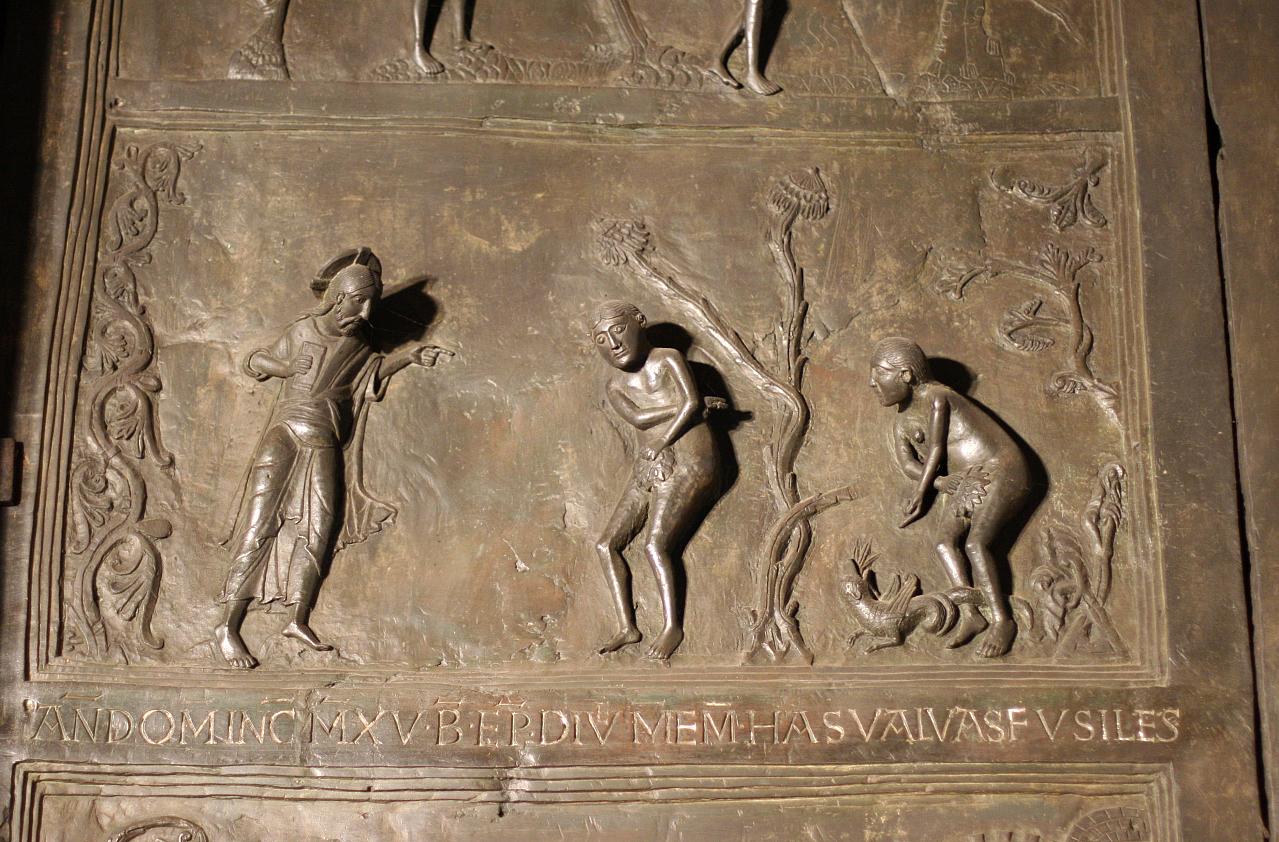
The Bernward Doors, dating from 1015, are large bronze doors cast for the Cathedral of St. Mary in Hildesheim Germany, under the direction of Bishop Bernward. Bernward had visited Rome and may have been inspired by the ancient carved wooden doors of the Basilica of Santa Sabina. These doors represented a massive project for the time, being one of the largest cast bronze objects ever made in northern Europe. The left door contains eight scenes from the life of Adam, and the right eight scenes from the life of Christ. The scenes are carefully chosen and matched to emphasize the theological idea that Christ was the new Adam. For example, the Fall is matched with the Crucifixion, by which the fall was redeemed. The "trial" of Adam and Eve by God, is matched with the trial of Christ by Pilate.

The figures are set in a schematic space with a few plants or architectural details representing landscapes. The figures are in high relief, some of the heads lean out and become free of the background. Yet these nods to three dimensional reality for the scenes are undercut by the tendency for details, such as feet to overlap and break out of the surrounding frames.


Image credits:

Full door from Wikipedia.
Details from Sacred Destinations on Flickr.

Thursday, December 9, 2010

Carpet Page, Lindisfarne Gospels

Cross posted from Monstrous Beauty

Others may rave about the Chi Rho monogram from the Book of Kells, but for my money, this is the single most impressive piece of illumination from the Middle Ages. This is one of the carpet pages from the Lindisfarne Gospels. It's said that each of the carpet pages in the Lindisfarne Gospels have an intentional error in the knotwork. Good luck finding it.

Wednesday, December 8, 2010

Lewis Chessmen

Cross posted from Monstrous Beauty


The Lewis chessmen are a group of chess pieces discovered on the Isle of Lewis in 1831. They were carved from walrus ivory and whale teeth in the 12th Century in Norway. There are 78 pieces: 8 kings, 8 queens, 16 bishops, 15 knights, 12 rooks, and 19 pawns, from as many as 5 different sets. The pieces were probably part of the stock of a trader dealing in luxury goods. Some of the pieces bear traces of red pigment, indicating that the two sides were white and red, unlike the modern white and black. Unlike modern chess sets, the rooks are portrayed as soldiers, including four berserks, chewing their shields, while the pawns are small geometric pieces, resembling standing stones.


The collection was split up soon after its discovery. The Museum of Scotland now owns 11 of the pieces, while the British Museum owns the balance. A exhibition of pieces from both the Museum of Scotland and the British Museum, along with related artifacts is currently touring Great Britain. I hope it come to North America.


Image credits:
Berserk Rook, Rook, and Knight, RobRoyAus on Flickr.
All others, Wikimedia Commons

Santa Sabina, exterior

Cross posted from Monstrous Beauty.


The Basilica of Santa Sabina is one of the oldest surviving early Christian basilicas. A few other basilicas are older (St Paul's Outside the Walls, St. Peter's, The Lateran) but they have all been substantially rebuilt or modified. Only St. Sabina's exterior remains close to the appearance of an early basilica.

Santa Sabina was built about a century after Constantine legalized Christianity. Although, it was not one of the original churches built under Constantine's patronage, but was built in the same style. The exterior is rather severe, without any external decoration. The clerestory windows above the aisles are filled with selenite rather than glass and allow large amounts of light into the interior. The interior was originally decorated with mosaics, but those are now lost. The original 5th century wooden door, carved with scenes from the Bible still exists.

Santa Sabina now serves as the mother church for the Dominican Order.

Image from Wikipedia.

Wednesday, August 18, 2010

The Nutting Girl

Cross posted from Dafydd's Random Music

"The Nutting Girl", sung by Ashley Hutchings and friends from the album Morris On. Ashley was a founding member of Fairport Convention, Steeleye Span, AND The Albion Band.

"The Nutting Girl" is a broadside ballad, several versions exist with minor variations. It was collected by Baring-Gould and printed in a bowdlerized form in Songs and Ballads of the West as "A-Nutting We Will Go". Most recordings, including this one, follow the version of Cyril Poacher collected and recorded by Alan Lomax and others. Watch out for singing plow-boys.


Tuesday, August 17, 2010

By Chance It Was

‎Cross posted from Dafydd's Random Music

"By Chance It Was" performed by Clannad. This was collected by Sabine Baring-Gould in Devonshire and tune and words were published in Songs and Ballads of the West in 1889. Baring-Gould cites earlier publications of versions of the lyrics in a volume in the British Library called The Court of Apollo, which may be the volume by Abraham Shackleton published in 1815 and The Songster's Favourite which I assume is Mirth and Glee, or the Songster's Favourite published in 1782.

Tuesday, July 27, 2010

Crown of Reccesuinth

Cross posted from Monstrous Beauty.

This is a votive crown given to the Church by Reccesuinth, King of the Visigoths (649 – 672). It is gold filigree set with sapphires, pearls and other gems and is the best surviving piece of Visigothic metalwork. The letters hanging from the crown spell [R]"ECCESVINTUS REX OFFERET" (King Reccesuinth offers this.) The crown is at the National Archaeological Museum of Spain is Spain except for the "R" pendant from RECCESVINTUS, which is in the Musée de Cluny in Paris.


Images from Wikipedia.

Monday, July 26, 2010

Orion from Leiden Aratea

Cross posted from Monstrous Beauty


Orion the Hunter from the Leiden Aratea. This is one of the great works of the Carolingian Renaissance, which how shows how thoroughly classical art was revived. This is such a close copy of its late antique model that is it was at one time thought to be of late antique provenence itself. Note the use of shading to model Orion's musculature. This had not been done in a realistic way for centuries when this manuscript was made. The text in this manuscript is know as the Aratea is by Germanicus and is based on the Phainomena of Aratus and is an introduction to the constellations. Germanicus is best remembered as the popular adoptive grandson of Augustus and grandfather of Nero. In Graves I, Claudius he was poisoned by Livia and Caligula. The Leiden university library has posted a digital facsimile of the manuscript here.

Leiden Aratea Leiden, Universiteitsbibliotheek, Voss. lat. Q 79, f. 58v.

Thursday, June 17, 2010

Child Ballad #10, The Cruel Sister

Cross-posted from Dafydd's Random Music.

Child Ballad 10: The Cruel Sisters, also known as The Twa Sisters. Evidently in addition to strange knights, you can't trust your sister either. Then there's the minstrel. If I find a dead body on the seashore, I'm not making a harp out of the bones. I guess I'll never be in a ballad. Sung by Pentangle.