Friday, December 10, 2010

Bernward Doors

Cross posted from Monstrous Beauty.


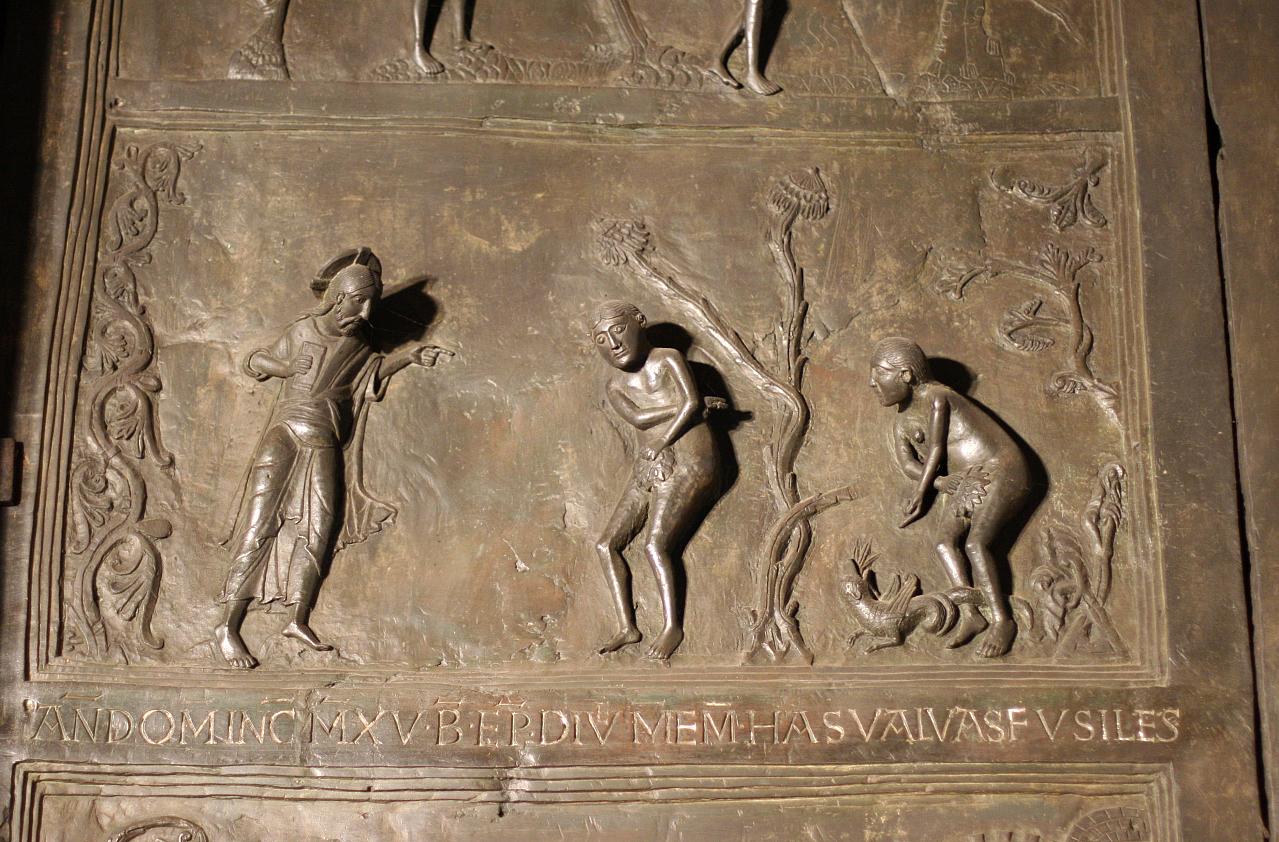
The Bernward Doors, dating from 1015, are large bronze doors cast for the Cathedral of St. Mary in Hildesheim Germany, under the direction of Bishop Bernward. Bernward had visited Rome and may have been inspired by the ancient carved wooden doors of the Basilica of Santa Sabina. These doors represented a massive project for the time, being one of the largest cast bronze objects ever made in northern Europe. The left door contains eight scenes from the life of Adam, and the right eight scenes from the life of Christ. The scenes are carefully chosen and matched to emphasize the theological idea that Christ was the new Adam. For example, the Fall is matched with the Crucifixion, by which the fall was redeemed. The "trial" of Adam and Eve by God, is matched with the trial of Christ by Pilate.

The figures are set in a schematic space with a few plants or architectural details representing landscapes. The figures are in high relief, some of the heads lean out and become free of the background. Yet these nods to three dimensional reality for the scenes are undercut by the tendency for details, such as feet to overlap and break out of the surrounding frames.


Image credits:

Full door from Wikipedia.
Details from Sacred Destinations on Flickr.

Thursday, December 9, 2010

Carpet Page, Lindisfarne Gospels

Cross posted from Monstrous Beauty

Others may rave about the Chi Rho monogram from the Book of Kells, but for my money, this is the single most impressive piece of illumination from the Middle Ages. This is one of the carpet pages from the Lindisfarne Gospels. It's said that each of the carpet pages in the Lindisfarne Gospels have an intentional error in the knotwork. Good luck finding it.

Wednesday, December 8, 2010

Lewis Chessmen

Cross posted from Monstrous Beauty


The Lewis chessmen are a group of chess pieces discovered on the Isle of Lewis in 1831. They were carved from walrus ivory and whale teeth in the 12th Century in Norway. There are 78 pieces: 8 kings, 8 queens, 16 bishops, 15 knights, 12 rooks, and 19 pawns, from as many as 5 different sets. The pieces were probably part of the stock of a trader dealing in luxury goods. Some of the pieces bear traces of red pigment, indicating that the two sides were white and red, unlike the modern white and black. Unlike modern chess sets, the rooks are portrayed as soldiers, including four berserks, chewing their shields, while the pawns are small geometric pieces, resembling standing stones.


The collection was split up soon after its discovery. The Museum of Scotland now owns 11 of the pieces, while the British Museum owns the balance. A exhibition of pieces from both the Museum of Scotland and the British Museum, along with related artifacts is currently touring Great Britain. I hope it come to North America.


Image credits:
Berserk Rook, Rook, and Knight, RobRoyAus on Flickr.
All others, Wikimedia Commons

Santa Sabina, exterior

Cross posted from Monstrous Beauty.


The Basilica of Santa Sabina is one of the oldest surviving early Christian basilicas. A few other basilicas are older (St Paul's Outside the Walls, St. Peter's, The Lateran) but they have all been substantially rebuilt or modified. Only St. Sabina's exterior remains close to the appearance of an early basilica.

Santa Sabina was built about a century after Constantine legalized Christianity. Although, it was not one of the original churches built under Constantine's patronage, but was built in the same style. The exterior is rather severe, without any external decoration. The clerestory windows above the aisles are filled with selenite rather than glass and allow large amounts of light into the interior. The interior was originally decorated with mosaics, but those are now lost. The original 5th century wooden door, carved with scenes from the Bible still exists.

Santa Sabina now serves as the mother church for the Dominican Order.

Image from Wikipedia.

Wednesday, August 18, 2010

The Nutting Girl

Cross posted from Dafydd's Random Music

"The Nutting Girl", sung by Ashley Hutchings and friends from the album Morris On. Ashley was a founding member of Fairport Convention, Steeleye Span, AND The Albion Band.

"The Nutting Girl" is a broadside ballad, several versions exist with minor variations. It was collected by Baring-Gould and printed in a bowdlerized form in Songs and Ballads of the West as "A-Nutting We Will Go". Most recordings, including this one, follow the version of Cyril Poacher collected and recorded by Alan Lomax and others. Watch out for singing plow-boys.


Tuesday, August 17, 2010

By Chance It Was

Cross posted from Dafydd's Random Music

"By Chance It Was" performed by Clannad. This was collected by Sabine Baring-Gould in Devonshire and tune and words were published in Songs and Ballads of the West in 1889. Baring-Gould cites earlier publications of versions of the lyrics in a volume in the British Library called The Court of Apollo, which may be the volume by Abraham Shackleton published in 1815 and The Songster's Favourite which I assume is Mirth and Glee, or the Songster's Favourite published in 1782.

Tuesday, July 27, 2010

Crown of Reccesuinth

Cross posted from Monstrous Beauty.

This is a votive crown given to the Church by Reccesuinth, King of the Visigoths (649 – 672). It is gold filigree set with sapphires, pearls and other gems and is the best surviving piece of Visigothic metalwork. The letters hanging from the crown spell [R]"ECCESVINTUS REX OFFERET" (King Reccesuinth offers this.) The crown is at the National Archaeological Museum of Spain is Spain except for the "R" pendant from RECCESVINTUS, which is in the Musée de Cluny in Paris.


Images from Wikipedia.

Monday, July 26, 2010

Orion from Leiden Aratea

Cross posted from Monstrous Beauty


Orion the Hunter from the Leiden Aratea. This is one of the great works of the Carolingian Renaissance, which how shows how thoroughly classical art was revived. This is such a close copy of its late antique model that is it was at one time thought to be of late antique provenence itself. Note the use of shading to model Orion's musculature. This had not been done in a realistic way for centuries when this manuscript was made. The text in this manuscript is know as the Aratea is by Germanicus and is based on the Phainomena of Aratus and is an introduction to the constellations. Germanicus is best remembered as the popular adoptive grandson of Augustus and grandfather of Nero. In Graves I, Claudius he was poisoned by Livia and Caligula. The Leiden university library has posted a digital facsimile of the manuscript here.

Leiden Aratea Leiden, Universiteitsbibliotheek, Voss. lat. Q 79, f. 58v.

Thursday, June 17, 2010

Child Ballad #10, The Cruel Sister

Cross-posted from Dafydd's Random Music.

Child Ballad 10: The Cruel Sisters, also known as The Twa Sisters. Evidently in addition to strange knights, you can't trust your sister either. Then there's the minstrel. If I find a dead body on the seashore, I'm not making a harp out of the bones. I guess I'll never be in a ballad. Sung by Pentangle.

Monday, April 19, 2010

15 years

Cross posted from The Weekend Scrub

Today I'm going to eat at Sonic.

Fifteen years ago was lying in bed reading when there was a loud noise and the house shook. I initially thought that a car had hit the house. I lived in Oklahoma City and I was three and half miles away from the Murrah Federal Building.

Within a couple of hours I was scrubbed in surgery at St. Anthony's. I was no longer an employee, having parted ways with the hospital almost a year earlier. I was part of three separate teams working at the same time on the most seriously wounded patient. I've been scrubbing for almost twenty years. I remember two patient names. This woman is one of them. (The other was named David Stapleton.)

At one point I went to see if I could help in instrument processing. St Anthony's was the nearest hospital to the federal building. (Close enough that the hospital building itself had minor damage.) Hundreds of walking wounded had found their way to the St. Anthony ER. Almost all of them had severe lacerations. The average hospital stocks maybe thirty suture trays. Luanna, the scrub in charge of processing, had her staff opening every tray we wouldn't being using that day, the GYN instrument and the like, and reassembling them into suture trays: Two hemostats, a needle holder, a pair of scissors and some forceps.

When I came out of surgery, I was surprised to find bags full of Sonic hamburgers. Someone at Sonic had figured that there would be a lot of people working a lot of hours at the hospitals who would not have much chance to eat. They made and sent thousands of burgers to every hospital in town without being asked.

Today I will say a prayer for the souls of the departed and a prayer for the continued health of the survivors and families. And I'll eat at Sonic.

Wednesday, April 7, 2010

The Sound of Surgery

Cross-posted from The Weekend Scrub.

I've mentioned elsewhere that the smell can be the grossest thing about surgery. Smell is not the most nerve wracking thing, though. Sound is. Not the sound of surgeons bellowing, but rather what is normally a quite normal sound, the pulse oximeter. For those not familiar with it, the pulse oximeter is a machine that measures the amount of oxygen carried by the blood. It does this by shining a specific wavelength of red light through a relatively thin body part, usually a finger. It then measures how much of that light is absorbed. From this it is able to calculate what percentage of the red blood cells are oxygenated. The best possible "score" is 100 (unless you are a member of Spinal Tap). Numbers above 96 are considered normal. Numbers below 90 are worrisome. The machine is also able to measure the pulse by measuring the time between each wave of freshly oxygenated blood. It has become one of the basic tools of anesthesia.

It has also has the best designed sound I have ever heard. It is the modern version of Monty Python's "machine that goes ping". Every time the curve peaks the machine makes an electronic "ping". Its the background noise of every OR. Most of the time it doesn't register on our consciousness. The genius in this sound is one feature: as the oxygen saturation decreases, the the tone of the "ping" lowers. A drop of 10 points will drop the tone over an octave. Since a decrease in saturation is often accompanied by a slowing of the pulse, the machine begins to sound like its battery is dying, which is the perfect metaphor, because that's what the patient is doing.

Believe me, a serious drop in the tone of a pulse ox will get everyone in the rooms attention.

This video shows the tone change in minor way. These tone changes wouldn't grab anyone's attention but they give an idea of what I am talking about. (Tone changes about 0:27 and 1:25)

Child Ballads, #2 The Elfin Knight

Cross posted from Dafydd's Random Music.

Child Ballad 2: The Elfin Knight. The core of this ballad includes demands by a woman that her suiter perform impossible tasks including making of a garment with no seams. One varient is widely known as Scarbourough Fair. This is not that variant. Sung by Kate Rushby.

Tuesday, April 6, 2010

Child Ballads

Cross posted from Dafydd's Random Music.

I've decided to see how many Child Ballads I can find.

Child Ballad 1: "Riddles Wisely Expounded" sung by The Askew Sisters. I never heard of them before I found this, but they are quite good.

Monday, April 5, 2010

Children

We, for some reason, have a lot a hard-boiled eggs in the house right now. Which means deviled eggs. The Younger Daughter was helping mash the yolks for The Wife when The Wife noticed that with each yolk the Younger Daughter was stabbing the yolk and then mashing it all while saying "First I pierce its heart, then I crush it." Sometimes my children frighten me.

Wednesday, March 31, 2010

Chi Rho monograms.

Cross posted from Monstrous Beauty

Last night I talked a bit about the Chi Rho monogram in the Stockholm Codex Aureus. It got me thinking about how often these monograms show up in insular gospel books. So I decided to see how may I could find and spent a couple of hours poking around looking for images of them. This is by no means a comprehensive list, but here are the ones I found, in roughly chronological order.

First up is the Book of Durrow, dating to the middle of the 7th century. The Chi is enlarged, the Rho slightly smaller, the whole line is enlarged and set off and colored yellow. It is n0t really known where the manuscript was made, although it was probably made somewhere in Ireland.

Durrow is followed by the Lindisfarne Gospels of about 7o0. This is a quantum leap with the Chi Rho dominating the page. The Chi and the Rho are extensively decorated. All of the text on the page is turned into one large decorative pattern. One of my favorite things about the Lindisfarne Gospels is how the artist would "draw" with the decorative red dots found in so many insular manuscripts. Here he has "written" with them to form the letters of the line following the Chi Rho monogram completely out of the red dots. The Lindisfarne Gospels are known to have been produced on the Island of Lindisfarne off the east coast of Northumberland.

Next up is an unnamed manuscript in the British Library (Royal MS 1 B VII). This is a smaller scale effort, as this is not as sumptuous of a manuscript. The zoomorphic Chi Rho Initial is as about as large as the initials which begins each of the gospels. The scribe started a new column at the Chi Rho initial, as if he were starting a new work, leaving the bottom of the left column blank. (The text in the obviously different script at the bottom of the left hand column is a later addition, a manumission of a slave in Old English.) This manuscript was produced in the first half of the 8th century in Northumbria.

Next is the St. Gall Gospels, now housed in the monastery at St. Gall in Switzerland. This manuscript was produced by monks in Ireland about 750 and brought with them when St. Gall was founded. By this point, Chi is taken over the page, leaving room for only a few words of additional text, which is so stylized and decorated as to be unreadable. (This and Lindisfarne are my two favorites.)

Next up is our friend from last night, the Stockholm Codex Aureus. This is somewhat more restrained, although the text is seen as a decorated pattern with legibility allowed to be lost to aesthetics. This manuscript was produced somewhere in Southumbria, probably Canterbury. The influence of the Roman Church mission at Canterbury probably exerted a restraining influence on the wilder "Celtic" traditions seen in more northern insular manuscripts. This manuscript dates to about 750.

This one needs no introduction. It is, of course, the Chi Rho page from the Book of Kells and easily one of the most famous manuscript images of the middle ages. Exuberance abounds and there is no restraint. (Despite its fame, I still like Lindisfarne better. Does that make me a heretic?)


This is from another unnamed manuscript in the British Library, (Royal MS 1 B VII). In a sense Kells was at once the culmination and last gasp of the Insular tradition. After Kells the Carolingian Renaissance got underway, and the insular style fell out of favor. The truly deluxe manuscripts of the era looked to classical models. Still some manuscripts were made in the Insular style. This manuscript is from about a century after Kells. Although the Chi Rho monogram is present it is more closely related to the zoomorphic initial of the other unnamed British Library manuscript than to the Durrow, Lindisfarne, St. Gall, and Kells.


This is from the the Bodmin Gospels which was made in the 9th or 10th century. This is not a deluxe manuscript, so, although the Chi is emphasized it is not a major piece of illumination.

This is from the Book of Deer, which was made in Scotland in the 10th century. One day I will have to talk more about this manuscript in detail. It is a relatively small scale, somewhat odd manuscript, but is clearly still following the Insular tradition.

This is the Corpus Irish Gospels, now owned by Corpus Christi College, Oxford. It was produced in the twelfth century, almost 500 years after the Book of Durrow. It, along with the next manuscript show the extreme tenacity with which this style had in Ireland. This monogram with its interlace decoration on spiral motifs would be at home in manuscripts centuries older.


My final manuscript is the Gospels of Mael Brigte, which are firmly dated by a colophon to 1138. Although simpler in decoration than the the Corpus Gospels, this manuscript is also done in the insular style, centuries after the style's high point and shows the enduring popularity of the style in Ireland.

Tuesday, March 30, 2010

Stockholm Codex Aureus

It's been a long while since I posted anything here, but I'm back, at least for the moment. Cross posted from Monstrous Beauty

This is the Stockholm Codex Aureus (Stockholm, Royal Library, MS A. 135), also known as the Codex Aureus of Canterbury. "Codex Aureus" can be translated as "Golden Book" and refers to the liberal use gold leaf used in the decoration of this manuscript. There are several other manuscripts known as the Codex Aureus as well, so you have to specify which one you are dealing with. Stockholm refers to its current location, while Canterbury refers to where it was probably made.

This is a Gospel Book and contains the Latin text of the four gospels. (I'm not sure what version, but I would bet that it is the mix of Vulgate and Vetus Latina found in other insular gospels). I also don't know what texts, other than the Gospels it contains, although I do know that it has Canon Tables. I would assume that some of the prefatory matter found in other Insular Gospels is present. There are 193 extant folios. Alternating folios have been dyed purple. The text is written in an uncial script in black, white, red, gold and silver inks. There are two surviving evangelist portraits, six decorated canon tables and seven decorated initials.

The portrait of Matthew shown here, is quite different from the highly stylized and abstracted portraits in other Insular manuscripts. Matthew is seated on throne within an arcade with pillars. Curtains hanging from above are wrapped around the pillars. In the tympanum above is his symbol, the winged man. There is little in the way decoration and the composition lacks the elaborate decorated borders found in some of the other insular manuscripts. Although the elements, including Matthew himself, are stylized and flattened the entire composition has a serene monumental quality. In many ways, this can be seen as a precursor to later Anglo-Saxon and Carolingian styles.

The facing text page, however, would be comfortably at home in any of the great Insular manuscripts like Kells or Durrow. The text block and each line of text is contained within a frame. The text lines alternate between a gilded background and golden letters, creating a dazzling effect. The opening initial is an elaborate monogram decorated with interlaced patterns and laid on a background of spiral motifs. As can be seen by the detail below, the draftsmanship is quite high.

That the evangelist portrait faces this page is quite interesting. The initial monogram is of the Greek letters Chi and Rho (XP). This monogram was often used as in place of the word for "Christ". The interesting thing is that, although evangelist portraits were usually placed at the beginning of a gospel, this is not the beginning of the Gospel of Matthew. This is the text which begins at Matthew 1:18. The preceding 17 verses contain a genealogy of Christ, and the actual narrative of Christ's life starts here. In insular manuscripts, the genealogy was often treated almost as a separate work and this "second beginning" was often given its own frontispiece, although this is the only manuscript that I am aware of that moves the evangelist portrait here. The enlarged, decorated Chi Rho monogram at this point in the text is a motif that is limited to insular gospel books.

This manuscript was at Christ Church, Oxford in the 9th century. It was looted by the Vikings, ransomed by Earl Alfred (later King Alfred). At some time in the middle ages it was lost again. It was found by a Swede in 1690 in Spain and purchased for the Swedish Royal Library

Monday, December 14, 2009

Just Do It.

Cross-posted from The Weekend Scrub

This is a bit of a rant.

I work weekends. I have to be able to do just about any case that comes along. I understand that the wimps fine scrubs who work during the week are stuck in their specialties and don't have a lot of exposure to other specialties. I don't care though. There are certain cases spread through all of the specialties that every scrub working in a large hospital must be able to do. (I may make a list of these someday.) If you can't do them, go work out an outpatient surgery center, or L &D, or specialty hospital and let your position be filled by a competent scrub. Even if you don't see them every day, you gotta be able to day a crani for subdural, a thoracoscopy, an ORIF and other procedures in the "scary" specialties of ortho, CV and neuro, even if you a GYN, or Plastics or General scrub. You just have to be able to do them, or get the hell out of here.

There, I feel better.

Monday, September 21, 2009

Wednesday, July 8, 2009

Bad scrub.

Cross posted from The Weekend Scrub.

So I've been following this story and giving it some thought.

Short synopsis: A hep C positive scrub in Denver was caught exchanging her dirty syringes filled with saline for fentanyl syringes, which she then shot up with. Thousands of people may have been exposed. After being fired from the Denver hospital she went to work at a one day surgery center where she worked until she was arrested. Hundreds of more potential exposures.

Some interesting tidbits: the hospital knew she was Hepatitis C positive, it showed up on her blood work when she was hired. They counseled her on a ways to avoid avoid exposing patients. A few news stories have made statements that she did not have patient contact. That can't be true, if she was in fact working as a scrub, unless reaching into a patient's abdomen and holding their intestines doesn't count as patient contact.

Also the news stories say that she was caught after being found in an OR which she was not assigned to. This is interesting, as, at every hospital I have worked at, people go into other rooms all the time to steal supplies or say hello to friends. The hospital must have had serious suspicions about her, or she was found messing with the anesthesia stuff. Some of the articles mention a previous drug test which came back negative, so the hospital was probably suspicious.

The fact that she was going into other ORs explains those high numbers of potential exposures. She only worked at the hospital for about six months, so that's about 130 working days. She would have had to have been stealing dozens of syringes a day to actually expose thousands of people. In fact the hospital is testing every one who had surgery at the hospital when she was at work. Of those "only" a hundred or so will be at serious risk of exposure. Pretty horrific, but not quite as scary as the headlines.

I'm still flabbergasted at the substitution of her dirty syringes. Why? Stealing drugs I can understand, that's what addicts do. But exposing people? Surgery departments are awash with syringes. Finding sterile syringes would be quick and easy. Sterile saline is likewise easy to find. I can think of only three reasons why she reuse her dirty syringes: She was paranoid that the extra syringes would be missed; second, she didn't have access to the proper labels for the syringes, or the original labels could not be removed from the original syringe. Not having a proper label on her replacement syringe would expose her quickly. Finally she may have been an evil bitch who wanted to infect other people.

My final thought is that, without taking away any of her responsibility, there are others who have seriously screwed up here. There is no way that she should have been able to go get Fentanyl syringes. Narcotics are suppose to be strictly controlled. Ideally, an anesthesia provider should never draw up a narcotic until he or she is ready to give it. What was obviously happening was that anesthesia was pulling up drugs, setting them down, and leaving the room. Stupid. Especially, as seems likely, there was a staff person about whom the hospital had suspicions of drug abuse.

General badness all around.

Thursday, June 25, 2009

Farrah Fawcett, R.I.P.

I am going duplicate a thousand of blog posts across the internets today. Farrah Fawcett lost her battle with cancer today. She was 62. Although her one season stint on Charlie's Angels is what made her famous, she, of course, was most famous for the poster. As does every other male of a certain age, I have fond memories of that poster.

An interesting, to me at least, side note when I was at school in Austin, my wife worked at the Umfaulf Sculpture Garden. The Garden showcases the work of Charles Umlauf, who taught sculpture in the art school at UT. In the seventies one of his models was Farrah. He made several busts of her. Here's the most recognizable, it has the hair.


And of course the poster.